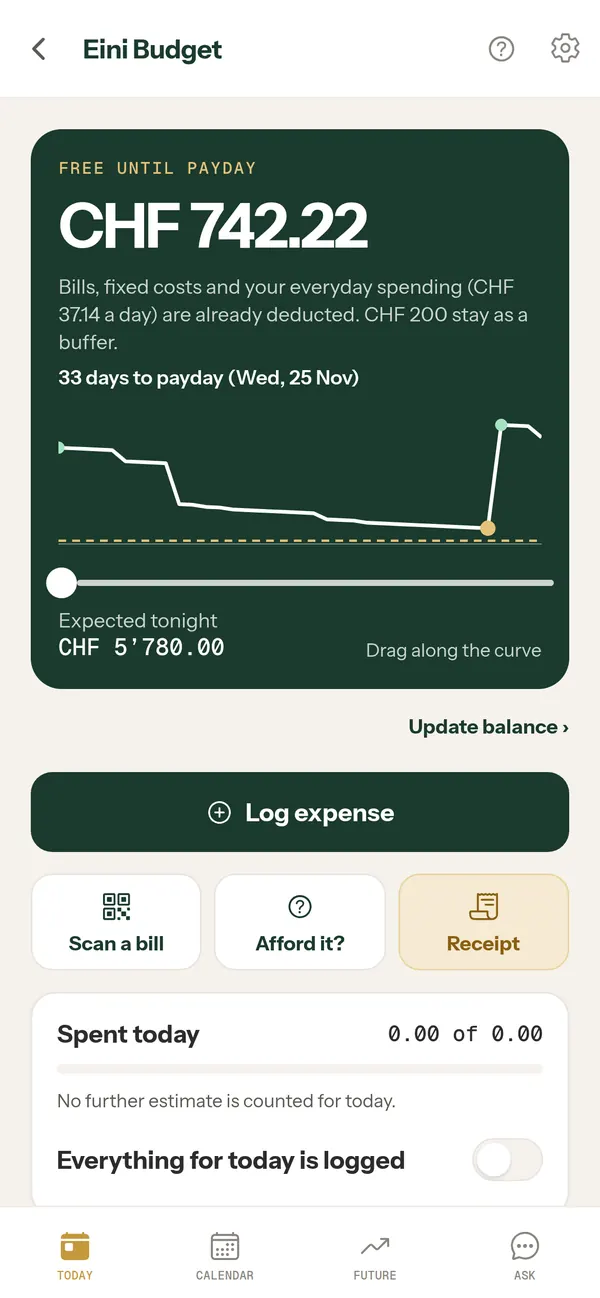
Planning a budget comes down to one thing above all: knowing how much money is really free until your next payday. In the worked example below, the account holds CHF 5'780.00 on the evening of 23 October 2026, but only CHF 742.22 is free until payday on 25 November.
Our verdict: Never plan with your balance, but with the lowest balance before your next payday, minus a buffer: only that amount is free. In the worked example, with the balance on 23 October 2026, that is CHF 742.22 of CHF 5'780.00.
Eini Budget does exactly this calculation for you, without connecting to your bank.
As of 25 October 2026.
Key takeaways
- In the worked example (balance CHF 5'780.00 on 23 October 2026, payday on 25 November), CHF 742.22 stays free until payday, which is 12.8%.
- The radio and TV fee costs CHF 335 per household in 2026 and CHF 312 from 2027 (DETEC, January 2026): plan for it in the month the bill arrives.
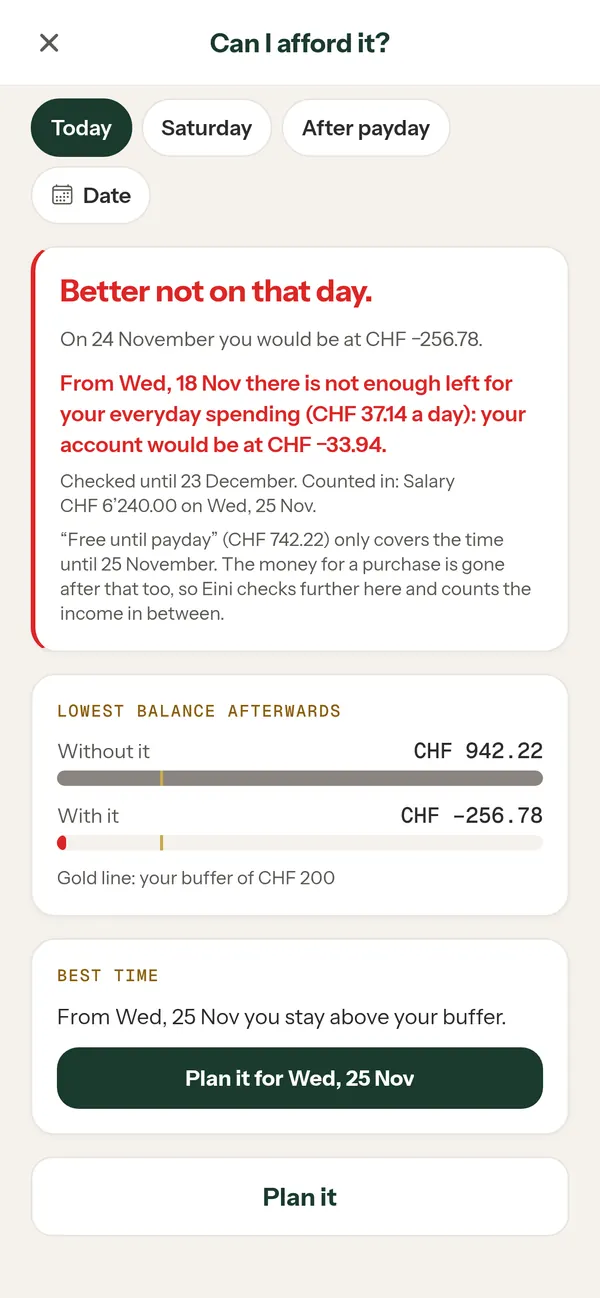
- In the example, a purchase of CHF 1'199.00 only fits after payday: if you bought it on 23 October, the account would be at CHF -256.78 on 24 November.
How much money is really free until payday?
Free is what remains at the lowest point before payday, minus a buffer. The lowest point is almost always the day before payday: by then all bills are paid, and the salary has not arrived yet.
The calculation has three steps: from your balance, you subtract all payments up to the day before payday, then your everyday spending (amount per day times days), and finally you set aside the buffer you never want to spend.
Source: worked example, balance on 23 October 2026.
| Item | Payment date | Amount |
|---|---|---|
| Taxes (instalment) | 28 October | CHF 640.00 |
| Rent | 1 November | CHF 1'980.00 |
| Health insurance | 1 November | CHF 438.40 |
| Public transport pass | 3 November | CHF 87.00 |
| Gym membership | 5 November | CHF 79.00 |
| Radio and TV (Serafe), annual bill | 12 November | CHF 335.00 |
| Mobile plan | 15 November | CHF 89.90 |
| Everyday spending, 32 days at CHF 37.14 | 24 October to 24 November | CHF 1'188.48 |
| Buffer | stays in the account | CHF 200.00 |
| Free until payday | until 24 November | CHF 742.22 |
Which fixed costs belong in your budget?
Fixed costs are payments of a fixed amount on a fixed date. In the example, CHF 3'649.30 goes out before payday, which is 63.1% of the balance.
- Rent: usually due on the first of the month, CHF 1'980.00 in the example.
- Health insurance: the monthly premium stated in your policy, assumed to be CHF 438.40 in the example (freely chosen, not the premium of any particular insurer, franchise or region). The new premium applies from January 2027; how it changes depending on the insurer is shown in the comparison of the 2027 premiums.
- Taxes: if you pay in instalments, plan each instalment on its date, in the example CHF 640.00 on the 28th of the month. Eini's tax module gives you an estimate based on official data from the Federal Tax Administration (FTA).
- Subscriptions: mobile, public transport pass and gym, together CHF 255.90 a month in the example.
What lands in your account after all deductions from your gross salary is explained in our post on gross vs net salary.
Why annual bills blow the monthly budget
A bill that comes only once a year does not show up in any normal month, which is why it is often missing from the budget. The radio and TV fee costs CHF 335 per household and year in 2026; in 2027 the Federal Council lowers it to CHF 312, and in 2029 it will be down to CHF 300 (DETEC, factsheet of 21 January 2026 (in German)).
Every household belongs to one of twelve billing groups: the annual bill comes in the same month every year and must be paid within 60 days, quarterly bills within 30 days. If you put money aside for it every month, you need CHF 27.92 in 2026 and CHF 26.00 from 2027.
In the example, the Serafe bill arrives on 12 November and is paid straight away; we use CHF 335.00. A bill from November 2026 covers the months up to October 2027 and may be lower because of the reduction.
How much everyday spending should I count per day?
Everything that is not fixed counts as everyday spending: groceries, eating out, spending on the go and odds and ends. The easiest way to start is with an estimate per week, divided by seven: CHF 260 a week is CHF 37.14 a day.
After two weeks, you compare the estimate with what you actually spent and adjust it. You will find guide values for groceries alone, by household size, in our post on the grocery budget.
Worked examples
Example: single, city of Zurich, a laptop for CHF 1'199.00
- Without the purchase: lowest balance on 24 November CHF 942.22
- Purchase on 23 October: CHF 942.22 minus CHF 1'199.00 = CHF -256.78 on 24 November; from as early as 18 November, the money no longer covers everyday spending (CHF -33.94)
- Purchase on 25 November, after the salary of CHF 6'240.00: lowest balance before the December salary (23 December) CHF 1'591.86
Not before payday: from 25 November the purchase fits, with CHF 1'391.86 above the buffer
Example: same profile, Serafe bill forgotten
- Bills and fixed costs until payday without Serafe: CHF 3'314.30
- Seemingly free: CHF 1'077.22
- On 12 November, the annual bill of CHF 335.00 still goes out
You are counting on CHF 335.00 too much: if you spend the CHF 1'077.22, you end up at CHF -135.00 on 24 November instead of at your buffer of CHF 200.00
Tips: how to plan your budget until payday
- Use the payment deadline. The annual radio and TV bill gives you 60 days to pay, so in the example until January: if you only pay it on 25 November, after payday, CHF 1'077.22 is free until 24 November; the CHF 335.00 then comes out of your November salary.
- Only count the 13th-month salary in your budget once it is certain. Your employment contract sets when it is paid; more in our post on the 13th-month salary. If you put part of it into pillar 3a, you will find the maximum amounts in our post on pillar 3a 2027.
How to do it with Eini
Eini Budget works with the balance you type in and shows you “Free until payday”.
- Enter your balance and salary. You type in your balance, net salary and payday, plus a 13th-month salary if you get one.
- Enter your fixed costs. You can carry over rent, health insurance and taxes from the other modules; you confirm them. You add any other fixed costs and planned expenses yourself.
- Log your expenses. In the app, with a widget, with Siri on the iPhone or in the reply field of the evening reminder. A photo of a receipt is read once and not stored.
- Plan your QR-bills. Photograph the payment part or choose a PDF: with a photo, your phone reads the QR code and only its text goes to Eini; a PDF is read on Eini's server and not stored. You still pay in your e-banking; afterwards, you mark the bill as paid.
- Ask before you buy. “Can I afford it?” checks the purchase day by day and names the best time, in the example 25 November.
Eini Budget is part of Eini Premium: in the app, CHF 3 a week or CHF 90 a year, with a 7-day free trial. The app does not connect to your bank and never pays anything. More on the budget app for Switzerland page.
How we calculated
- Profile: a worked example, not a real person: single, living in the city of Zurich, net salary CHF 6'240.00 on the 25th of every month, plus a 13th-month salary in December. All amounts are assumptions, not averages. The screenshots above show the same profile (app 2.1.0).
- Calculation: free = balance minus all payments up to the day before payday, minus everyday spending, minus buffer. Everyday spending counts from 24 October, because the balance was entered on the evening of 23 October: 33 days to payday, 32 of them with everyday spending. We check the purchase up to the day before the December salary (23 December), as in the app screenshot.
- Payday: if it falls on a weekend or a bank holiday, the bank business day before applies, as in the app: 25 October 2026 is a Sunday (salary on 23 October), and 25 December is a holiday (salary on 24 December).
- Sources: radio and TV fee 2026 to 2029: DETEC, factsheet of 21 January 2026 (in German). Billing groups and payment deadlines: OFCOM, Amount and billing (accessed 25 October 2026).
- Not included: interest, credit card statements, irregular income and additional tax payments.
- As of 25 October 2026.
Frequently Asked Questions
How much money is free until payday?
Your balance minus all payments up to the day before payday, minus everyday spending, minus your buffer. In the worked example, with the balance on 23 October 2026, this leaves CHF 742.22 of CHF 5'780.00 free.
Does the Serafe fee belong in the budget?
Yes, as an annual bill in the month it arrives: in 2026 it costs CHF 335 per household, in 2027 CHF 312 (DETEC, January 2026). The annual bill must be paid within 60 days (OFCOM).
What counts as fixed costs?
Everything with a fixed amount and a fixed date: rent, health insurance premium, tax instalments, subscriptions and annual bills. In the worked example from October 2026, they come to CHF 3'649.30 until payday.
How much money should you plan for everyday spending?
An estimate per week, divided by seven: CHF 260 a week is CHF 37.14 a day. After two weeks, you replace it with your real average (worked example, October 2026).
What happens if payday falls on a weekend?
When the salary arrives in that case is set by your employment contract. In the worked example, the bank business day before applies: 25 October 2026 is a Sunday, so the salary arrives on Friday, 23 October.
Can Eini work this out for me?
Yes, with Eini Budget: you type in your balance, and the app deducts bills, fixed costs and everyday spending until payday and leaves your buffer untouched. Without any connection to your bank. Eini Budget is part of Eini Premium: in the app, CHF 3 a week or CHF 90 a year, with a 7-day free trial (as of October 2026).
What is really free until payday?
Eini Budget works it out for you, without connecting to your bank.
Download